A free daily pool maintenance log with the fields most county health departments require: chlorine, pH, alkalinity, clarity and flow, checked through the day. No email, no sign-up — download it below.
PDF · US Letter + A4 · Instant download
Free for personal use · No email required · Print as many copies as you need
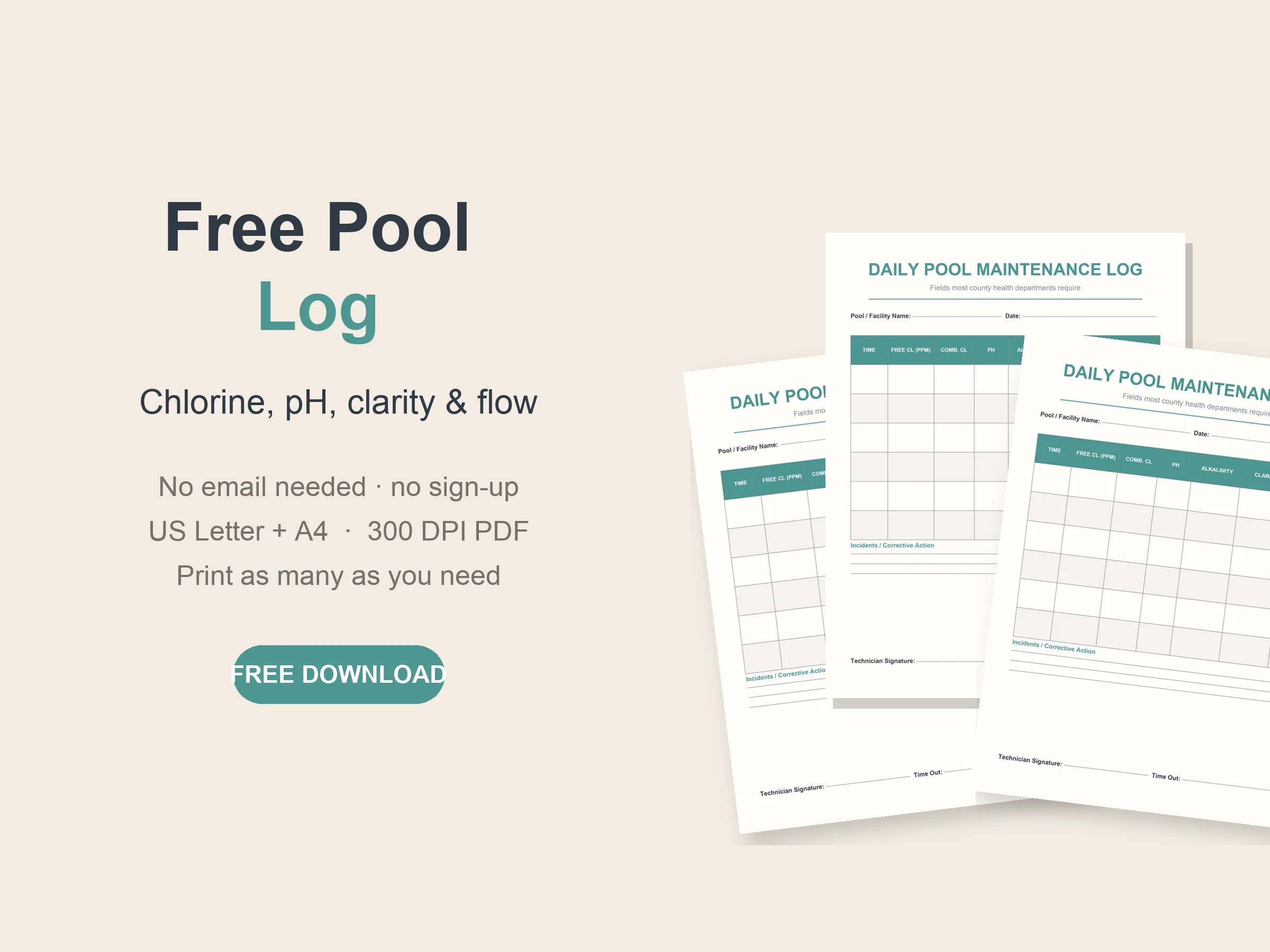
One page per day, sized for a clipboard by the pump room.
Rows repeat through the day, so one sheet covers open to close.
The paperwork is only as good as the habit behind it. Here's what makes a daily log hold up.
Most health departments set a fixed testing interval for public and semi-public pools — often every two to four hours while the pool is open. Match the log's rows to your permit's schedule, not to whenever the pump room is quiet.
"3 ppm" and "7.4" hold up in an inspection; a tick box does not. Recording the actual reading is what turns a log into evidence the water was safe, not just a habit that was followed.
Inspectors typically ask to see a recent run of logs, not just today's sheet. Keep completed pages in a binder by the equipment room so a spot inspection never catches you searching for last month's paperwork.
Public and semi-public pools — HOA pools, apartment complexes, hotels, gyms, schools — are near-universally required to keep a written water-testing log on site, and the specific fields vary by state and county health code. Most ask for free available chlorine, pH, and a note on clarity at minimum; many also ask for combined chlorine (to catch chloramine build-up), total alkalinity (to keep chlorine and pH stable), and filter pressure or flow (to catch a failing pump or clogged filter before it becomes a closure). This log covers all of those in one row, so a single reading takes one line instead of five separate notebooks. For the full daily/weekly/monthly task breakdown and CDC chemical targets, see our pool maintenance schedule guide.
The gap that gets pools cited isn't usually a bad chemical reading — it's a missing log entry. An inspector who can't verify the water was tested during a busy Saturday afternoon has no way to confirm it was safe, even if every other reading that week was perfect. A sheet taped to the pump room door, filled in at the same times every day, closes that gap for the cost of a pen.
The free daily log is the habit. The $7 pack is the rest of the season's paperwork.
PDF · US Letter + A4 · Instant download
🔒 Secure checkout via Gumroad
Yes. One full page, no email address, no watermark and no expiry, in both US Letter and A4. It's the same design that opens the $7 pack, not a cut-down version.
Most US health codes ask public pools to test free chlorine and pH at set intervals through operating hours — commonly every 2 to 4 hours — and to keep the written log on site. Exact intervals and required ranges are set by your state or county, so check your permit or local health code.
It covers the fields most county health department logs ask for — chlorine, pH, alkalinity, clarity and flow — but requirements vary by state and county. Compare it against your local health department's log sheet before relying on it for inspection.
US Letter for the United States and Canada. Both sizes are included as separate downloads, free and in the paid pack.
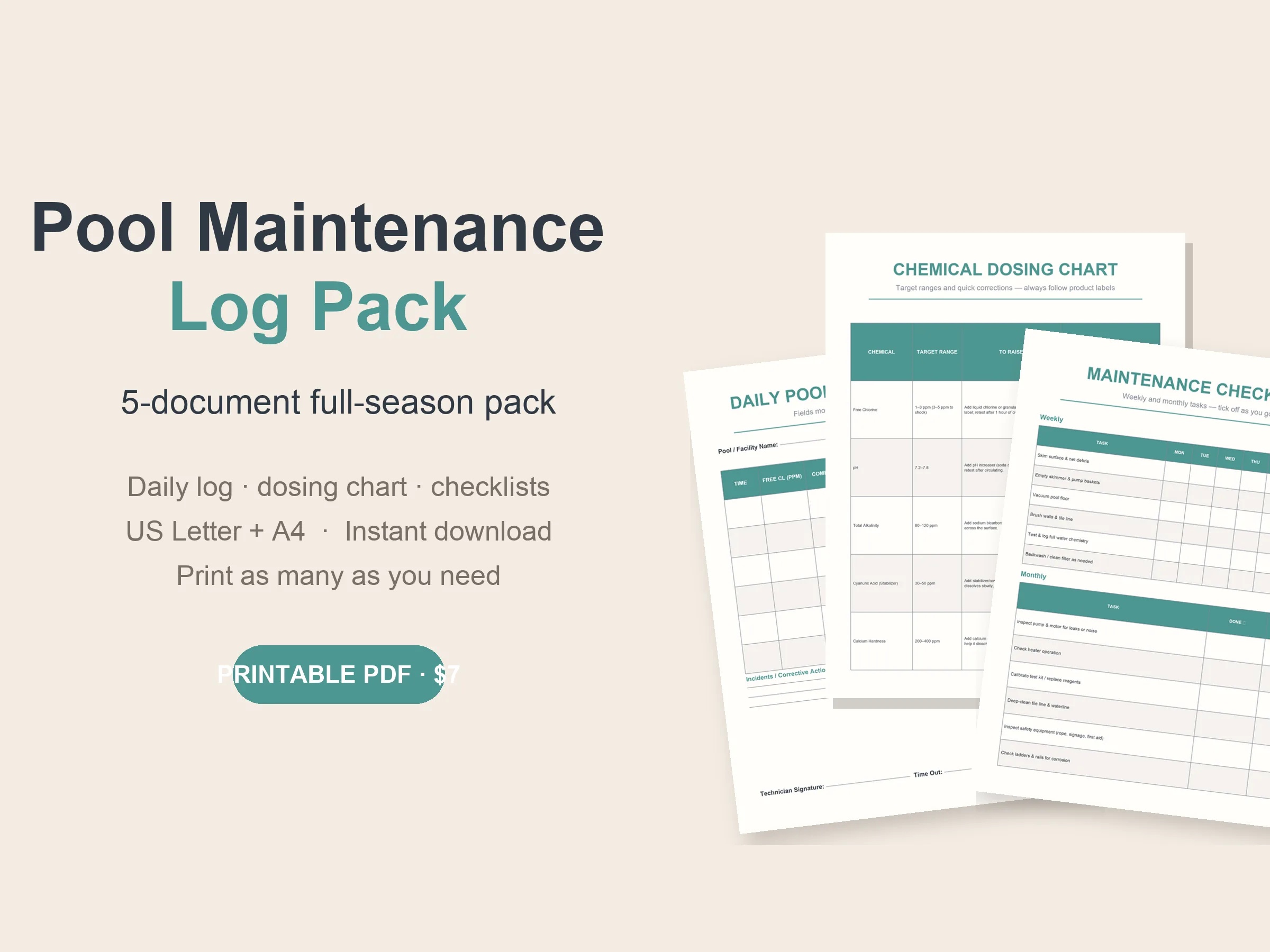
Four more sheets: a monthly log grid for a one-row-per-day season overview, a chemical dosing chart, a weekly and monthly maintenance checklist, and an incident report sheet. The free daily log is included unchanged.
Free monthly fire drill log for licensed childcare centers, plus a 5-document compliance pack.
Free + $7
Free tool sign-out log for job sites & shops, plus a 5-document tool-tracking pack.
Free + $7
Free daily trip sheet for truckers, plus a 5-document IFTA, fuel & expense pack.
Free + $10