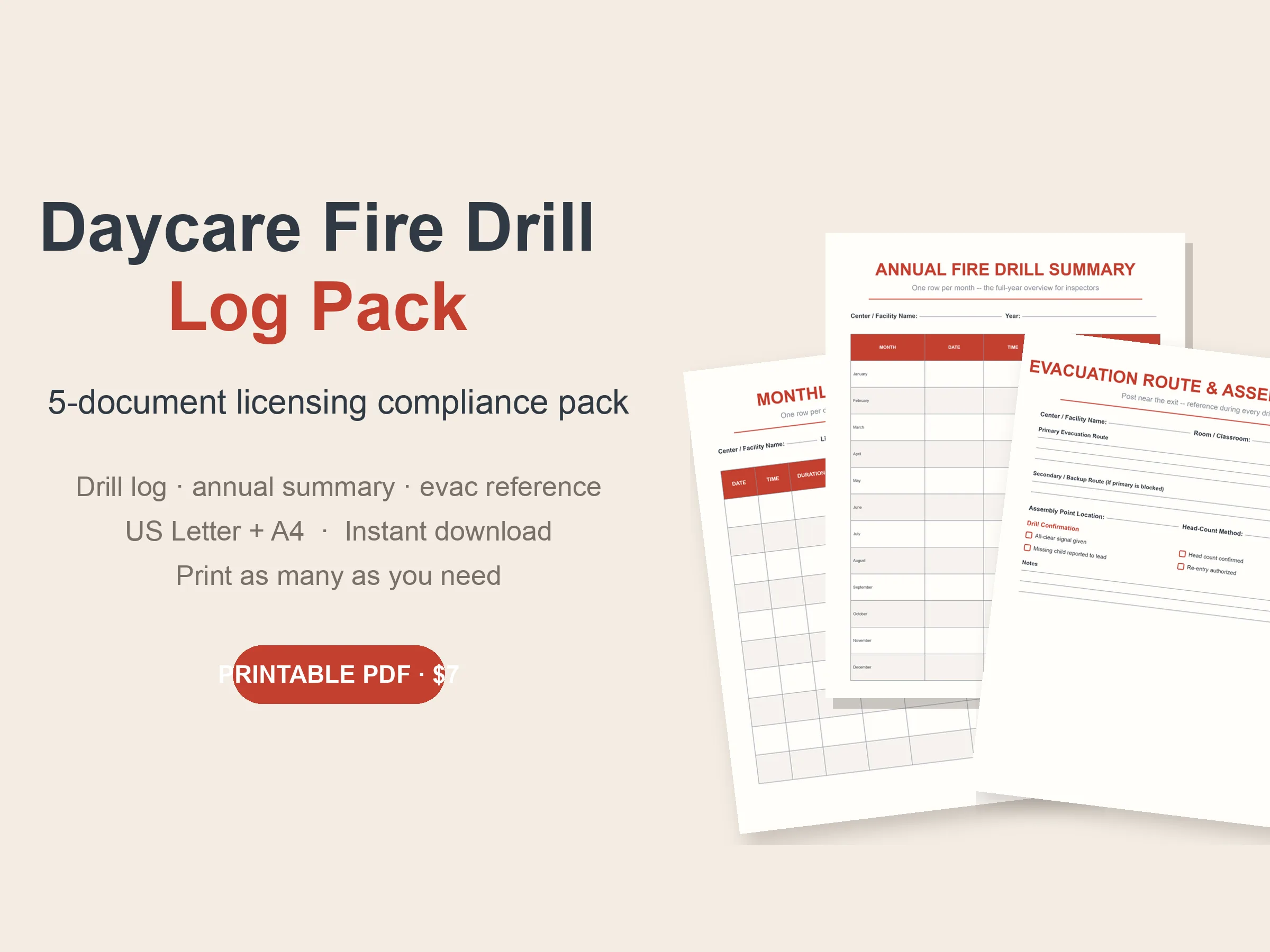
Get the log this guide describes
The free monthly fire drill log covers the fields inspectors check across every state above — plus a 5-document compliance pack if you want the rest of the paperwork ready too.
How often licensed child care centers must run fire drills in 8 major states, what an inspector checks in the log, and how long to keep the records.
Most states license child care centers to conduct fire (evacuation) drills on a set schedule — usually monthly — and to keep a written record of each one: date, time, evacuation route, headcount, and how long the evacuation took. Requirements vary by state, and a few states set a different interval than monthly. Below are eight states' actual rules, each checked against the state's own regulation.
| State | Drill frequency | Citation | Record-keeping rule |
|---|---|---|---|
| California | Every 6 months | Cal. Code Regs. tit. 22, §101174 (centers); §102417 (family child care homes) | Documentation kept on-site at least 1 year |
| Texas | Monthly | 40 Tex. Admin. Code §746.5205 | Documented on file: date, time, evacuation length |
| Florida | At least 10 times per licensure year, no less than 30 days apart | Fla. Admin. Code r. 65C-22 | Written record of date, headcount, route, evacuation time; available at inspection |
| New York | Monthly (each shift of care) | 18 NYCRR Part 418 | Record of each drill kept on file on OCFS forms or approved equivalent |
| Pennsylvania | Every 60 days | 55 Pa. Code §3270.94 | Drills at varying times/locations, documented on-site |
| Illinois | Monthly (centers) | 89 Ill. Admin. Code Part 407 | Fire prevention inspection monthly by a trained staff member; drills recorded |
| Ohio | Monthly | Ohio Admin. Code 5180:2-12-16 | Written documentation on-site: date, time, headcount, route, evacuation time |
| Georgia | Monthly | Ga. Comp. R. & Regs. (Bright from the Start rules) | Each drill documented; children accounted for and plan followed |
A few things stand out in the table. California and Pennsylvania are outliers on frequency — every 6 months and every 60 days, respectively — while the rest default to monthly. Florida's rule is written as a per-year minimum with a spacing rule rather than a flat "once a month," which trips up centers that assume monthly automatically satisfies it (10 drills spread across 12 months, at least 30 days apart, still needs deliberate scheduling).
Retention rules are the least standardized part of this. California requires records on-site for at least one year. Other states specify the log must be "on file" or "available for inspection" without stating an exact retention period in the sections reviewed here — in practice, licensing agencies expect records covering at least the current and prior licensing year. Where a state doesn't publish an explicit retention duration, the safer default is to keep at least 12 months of drill logs on hand and never discard a log before the next licensing renewal or inspection cycle.
Fire drill logs are one of the simplest things a licensing inspector checks and one of the easiest things to get flagged for — usually not because the drill didn't happen, but because the paperwork wasn't kept up to date or wasn't on hand when asked for. A dated log filled in the same day as each drill is the fix for both problems.
The free monthly fire drill log covers the fields inspectors check across every state above — plus a 5-document compliance pack if you want the rest of the paperwork ready too.
Free daily pool log for chlorine, pH & flow, plus a 5-document full-season pack.
Free + $7
Free tool sign-out log for job sites & shops, plus a 5-document tool-tracking pack.
Free + $7
Two pages from the chore chart pack, free — no email, no sign-up.
Free